From Jamie
Buying a Home in Central Oklahoma? Look Beyond the List Price.
A thoughtful Central Oklahoma buyer’s guide to the costs, coverage, property details, and everyday priorities that matter beyond the list price.

You should be able to love your home and feel comfortable with what it takes to own it.
When you start looking, it’s natural to focus on the price, the photos, and whether you can picture yourself walking through the front door. Those things matter. But before you fall in love with a home, I want us to understand the details that will matter after you get the keys.
What will the monthly payment really look like? What does the insurance cover? How much life is left in the roof? And does the location work for the way you actually spend your days?
Whether you’re considering Oklahoma City, Edmond, Norman, Yukon, Piedmont, or somewhere else in Central Oklahoma, those answers belong in the conversation early. My goal is to help you find a home you feel good about buying—and living in.
Start with the life you want, then build the budget
Before we talk about how many bedrooms you need, I want to know what you want your move to make possible. A shorter drive? Space to work quietly? A yard you enjoy without spending every weekend maintaining it? Being closer to the people and places you see most?
Those priorities help us decide where your money will make the biggest difference. They also help us recognize when a beautiful house asks you to give up something that matters more.
Your lender’s approval and your personal comfort level answer different questions. Approval tells us what financing may be available, subject to the lender’s requirements. Your budget tells us what leaves room for the rest of your life. Start with a payment that feels manageable alongside savings, transportation, childcare, travel, and the things you don’t want homeownership to crowd out.
If you’re early in the process, my homebuying guide is a helpful place to begin. We can build the search around your priorities rather than letting a search filter set them for you.
Look at the full monthly cost of the address
The list price is one number. Owning the home involves several.
Ask your lender to explain principal and interest, estimated property taxes, homeowners insurance, and any mortgage insurance. Then add expenses that may sit outside the mortgage payment: association dues, utilities, lawn care, and a maintenance allowance. If a payment estimate includes an escrow account, check exactly what it includes so you don’t count the same expense twice.
A house with a lower price can still put more pressure on your monthly budget if its insurance, maintenance, or association costs are higher. Another home may cost more upfront but need fewer immediate projects. Neither possibility makes the decision for you; it gives us a better comparison.
Write the numbers side by side for your strongest options. Keep confirmed quotes separate from estimates and identify what still needs checking. The Consumer Financial Protection Bureau’s home-selection guidance encourages buyers to revisit their total payment and budget as the search becomes more specific. That’s a useful habit to bring into every serious comparison.
Have the Oklahoma insurance conversation early
Insurance belongs near the beginning of your decision, not at the end of your closing checklist.
Once an address becomes a serious possibility, ask an insurance professional for a quote based on that property and your circumstances. Share the information they request about the home, including the roof and any known updates. A broad online estimate is a starting point; it is not a promise that a particular home can be covered at that price.
Compare coverage as well as premiums. Ask what is excluded, what deductibles apply, and whether the proposed coverage satisfies your lender. The Oklahoma Insurance Department’s homeowners guide recommends comparing equivalent policies and considering whether you could afford the deductible after a claim.
For wind and hail, ask the insurance professional to translate the deductible into dollars. If a proposed policy uses a 2% deductible on $350,000 of dwelling coverage, the arithmetic is $7,000. That is an illustration, not a quote or a statement about every Oklahoma policy. The percentage’s basis and the policy terms need to be confirmed.
Understanding that exposure helps you decide how much cash to keep available after closing.
Give the roof and the house a closer look
A freshly painted room can make a strong first impression. I also want you to understand the parts of the home that are expensive to repair and easy to overlook during a showing.
Ask about the roof’s age, available repair or replacement records, and any warranties. Have a qualified inspector assess its visible condition and recommend additional evaluation when appropriate. Ask the insurer separately how the proposed policy handles roof losses. Inspection condition and insurance coverage are related questions, but one answer does not replace the other.
The Oklahoma Insurance Department explains roof settlement differences, including actual cash value and replacement cost coverage. Ask your insurance professional which terms apply to the specific quote, including depreciation, exclusions, and any roof schedule.
Inside and outside, pay attention to drainage, heating and cooling equipment, electrical and plumbing systems, and signs that need professional investigation. A general inspection can identify concerns and recommend specialists; it cannot guarantee that every hidden condition will be found.
I can help coordinate questions and keep the findings organized. The condition judgments and repair estimates should come from the appropriate qualified professionals. What matters is making your decision with useful information, not a guess based on finishes.
Keep the inspection and appraisal in perspective
An inspection and an appraisal serve different purposes. The inspection helps you understand the condition of the home within the inspector’s scope. The appraisal supports the lender’s assessment of value for the loan. An appraised value does not mean the home has no repair needs, and a clean-looking inspection summary does not establish what you should pay.
Before you commit, ask how your contract handles inspection findings, appraisal results, and financing. Know the deadlines and how notices must be delivered. If a report raises a question, leave time for the appropriate professional to investigate it. We can keep a clear record of the questions, responses, and decisions, so you’re not trying to reconstruct an important conversation as a deadline approaches.
Check the property’s records, boundaries, and flood information
The address deserves its own research, even when you already know the neighborhood.
Confirm the county and municipality that actually serve the property. A mailing address, a community name, and a school district boundary do not necessarily describe the same geography. Verify school assignments directly with the district if they are important to your decision, and ask the relevant city or county about permits or proposed uses that matter to you.
Review the available tax records with your lender and closing team. The current owner’s tax bill is useful history, but don’t assume your future bill will match it. Ask the appropriate county assessor about valuation, exemptions, and the effect of a change in ownership. Oklahoma County buyers can start with the county assessor’s property records; homes elsewhere require the correct county’s records.
For Oklahoma City properties, the City of OKC’s flood-zone and insurance-map resources provide another research starting point. Ask about the specific parcel, any available flooding history, and insurance requirements. Being outside a mapped high-risk area does not promise that flooding cannot happen. Review drainage and coverage questions with the appropriate professionals.
Compare communities through your everyday routine
Central Oklahoma gives you a range of places to consider, but the best fit comes down to your own routine and the individual property.
Rather than assuming one city name tells us everything, we can compare specific addresses in Oklahoma City, Edmond, Norman, Yukon, Piedmont, and the Deer Creek area against your priorities. A citywide label won’t tell you the exact drive, maintenance needs, district assignment, or services for a particular home.
Try the commute at the time you would normally make it. Think about the trip to groceries, appointments, recreation, and the people you visit regularly. Walk through the floor plan with your actual day in mind. Where do bags land? Where would you take a call? Does the storage work for what you own?
If you’re comparing an acreage property with a home on a smaller lot, investigate the practical differences too: utilities, road access, mowing, fences, and any well or septic systems. Ask about service responsibilities rather than assuming they match your current home.
My Explore Communities page can help you begin narrowing the area. From there, we’ll keep the conversation focused on your needs and independently verified property details.
Build the offer around the whole transaction
A strong offer begins with the particular home, its competing alternatives, and your position as a buyer. It should not depend on a broad claim that every seller in Central Oklahoma will negotiate the same way.
We can review relevant comparable sales, the property’s condition, listing history, and current competition before deciding what to propose. Then we look beyond price to closing timing, financing, inspection provisions, and any requested seller contribution toward allowable costs.
A price reduction and a seller credit do different things. One changes the purchase price; the other may help cover eligible expenses, subject to the agreement and your loan’s rules. Ask your lender to show the effect on both cash to close and the payment. A credit that cannot be used under the loan terms is not the benefit it first appears to be.
Inspection requests should reflect findings, priorities, and the contract. Not every issue requires the same response. Some call for a specialist, some for negotiation, and some may lead you to reconsider the home within your contractual rights.
I’ll help you understand the choices. You should know what you’re agreeing to and what remains uncertain before you decide.
Compare financing without losing sight of cash to close
When you compare lenders, give each one the same basic scenario so the offers are meaningful: the same property, loan amount, down payment, loan type, and comparable rate-lock assumptions.
Look at the interest rate alongside points, lender fees, credits, and the estimated cash needed at closing. Ask what changes if you choose a different option and how long any quoted terms are available. The CFPB’s Loan Estimate comparison guide is a useful tool for working through those differences with your lender.
If a builder or seller offers a financing incentive, request the written details. Ask whether a particular lender is required, what fees apply, and how the offer compares with other financing available to you. If there is a temporary payment reduction, understand the payment after it ends and the terms that govern it.
Your decision should work with the financing you can obtain now. A possible future refinance is not a substitute for a payment you can comfortably carry today. Future rates, eligibility, fees, and property value are uncertain. We can keep the home search grounded in the numbers you have rather than a hoped-for change.
Ask about assistance—and understand what you are accepting
You don’t need to assume that a down-payment assistance program is either available to everyone or limited to one type of buyer.
The Oklahoma Housing Finance Agency’s homebuyer resources explain state program options and connect buyers with participating lenders. Ask a participating lender to review your situation, the property, and the current program requirements. Eligibility, loan terms, and availability need to be confirmed for your application.
Just as importantly, ask how the assistance is structured. Is there a lien? When would repayment be required? What happens if you refinance, sell, or stop using the home as your primary residence? OHFA’s down-payment assistance FAQs describe repayment obligations; don’t treat assistance as free money without reading the applicable terms.
The right question is whether the complete financing arrangement supports your plans. Ask for a clear comparison of the options, including the first mortgage, assistance obligations, fees, and your expected time in the home. Your lender can explain the financing; I can help keep the property search aligned with the plan you choose.
Protect a little breathing room after closing
There is a difference between having enough to close and having enough to settle in comfortably.
Before choosing how much cash to put into the purchase, consider the expenses that arrive around the move: inspections, moving services, utility setup, window coverings, appliances, and anything you expect to repair soon. Confirm which costs are paid before closing, which appear on the closing statement, and which belong in your first few months of ownership.
Keep a separate list of known projects and unknowns. A written estimate for a needed repair is more useful than a hopeful allowance. For an older home, consider the age and condition of major systems when setting a maintenance reserve. For new construction, review what the builder includes, the warranty process, and the responsibilities that still belong to you.
There is no single reserve amount that fits every buyer or every house. Work through your circumstances with your lender or financial professional. My role is to help bring property-specific questions into that conversation so the home you choose leaves room for living, not just making the next payment.
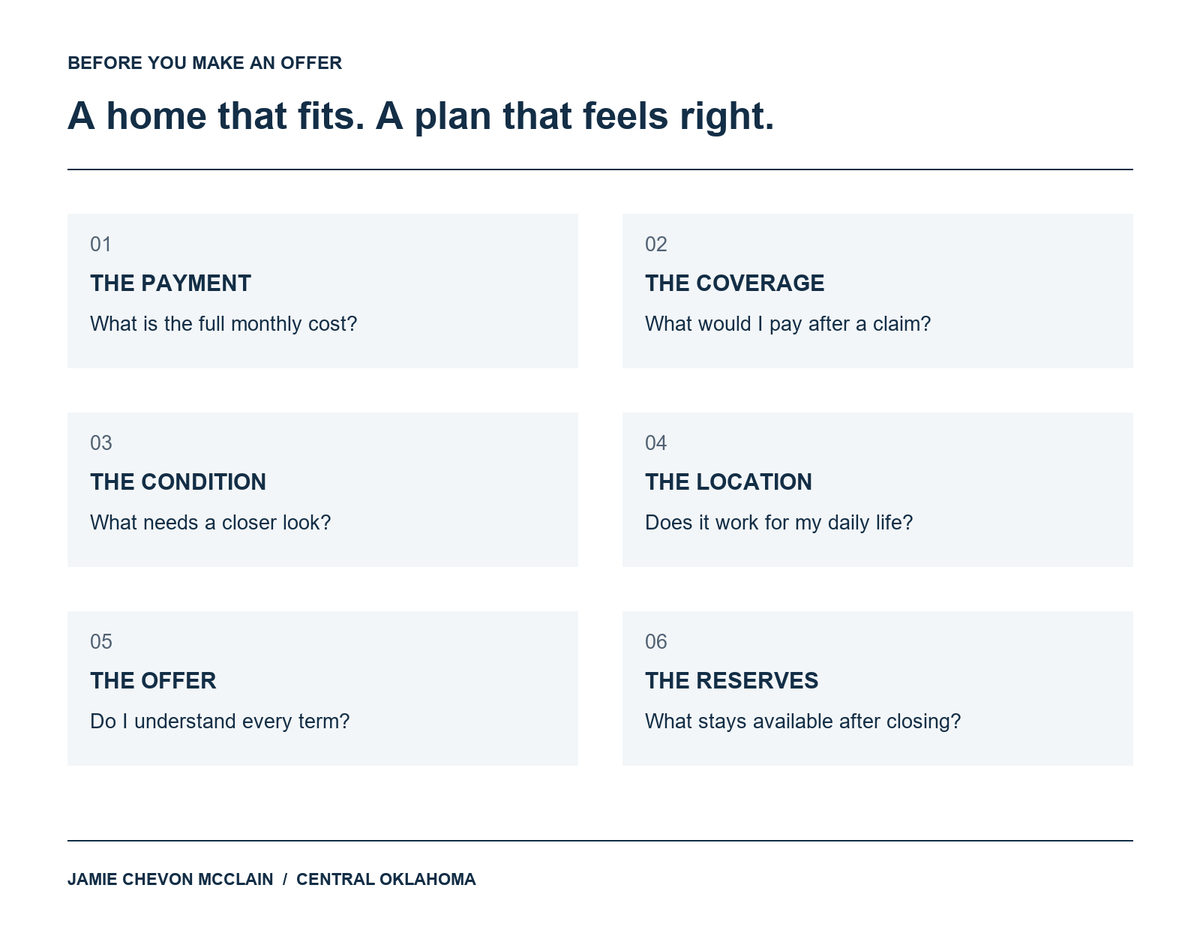
Before you make an offer: your buyer checklist
Use these questions to bring the conversation back to the details that matter:
- Does the estimated total payment fit my own budget, not simply my approval limit?
- Have I received a property-specific insurance quote and understood the deductibles and roof coverage?
- What do we know about the roof, major systems, drainage, and any recommended specialist evaluations?
- Have I checked the correct county’s tax information and asked about my likely ownership costs?
- Do the location, verified services, and actual commute work for my routine?
- Do I understand the proposed contract terms, deadlines, credits, and financing assumptions?
- Have I separated cash to close from moving expenses, planned repairs, and reserves?
You don’t have to have every answer before we begin looking. We just need a thoughtful way to find the answers before they become commitments.
Let’s find a home that fits your next chapter
Buying a home is personal. The right decision needs to make sense on paper and feel right for the life you want to build.
If you’re planning a move in Oklahoma City or Central Oklahoma, I’d love to hear what you’re considering. We can talk through your priorities, bring the right professionals into the conversation, and create a plan that lets you move forward with more clarity.
Start with my buyer resources, get to know my approach, or tell me what home means to you. If your purchase depends on selling your current home, we can also begin with a thoughtful selling plan.
You don’t need to have it all figured out. A good conversation is a place to start.
*Written by Jamie Chevon McClain, REALTOR®. Resources reviewed October 19, 2026. This guide provides general homebuying information; property conditions, insurance, financing, taxes, and contract rights require advice specific to your situation from the appropriate professionals.*